Vyner Street Gallery - 30th August 2011 - 5th September 2011 //////////////
A text written in response to the show, by Natasha Rees.
“Anguish only is sovereign absolute. The sovereign is king no more: it dwells low-hiding in big cities. It knits itself up in silence, obscuring its sorrow. Crouching thick-wrapped, there it waits, lies waiting for the advent of him who shall strike a general terror; but meanwhile and even so its sorrow scornfully mocks all that comes to pass, all there is.”
Opening of Madame Edwarda, Georges Bataille, 1956.
This first unique, collaboration between Chris Shaw and Scott Daniel Faulkner, presents a variety of 2d artworks by Shaw and four short videos by Faulkner. Shaw invited Faulkner to partake in this exhibition - but not from the usual perspective of two artists working together, rather to experiment with how their similar sensibilities play out in very different ways within the parameters of an exhibition. Whilst Faulkner is pointedly not an artist, he and Shaw share a dark (and at times fey) humour that becomes evident across their very separate projects. Together, the works invite readings of hiding and revealing; reclusivity and effusiveness, as well as that which is embedded within a collective cognisance of historical culture (for Shaw and Faulkner, mainly literature, music and art). However, at the exhibition’s heart is a sense of refutation by both men, of minor and major questions held by humanity and how ‘the cult’ of individuality, choice and notions of success reverberate in a 21st century world.
The title of this exhibition, Vaudoux Follies, combines a now defunct spelling of voodoo (a term that transpires from the merging of two religions – namely, African cult worship and aspects of French Catholicism, typified by the worship of, and incantation through, fetish objects, originally practiced by African Slaves in the Caribbean, in the 16th century); and Folie à deux; a psychiatric term used to describe the transmission of a delusional belief between two people. The idiosyncratic exchange of ideas and everyday life stories between Shaw and Faulkner is partly crystallised and formalised within their display at Vyner Street. Associations from the title serve also as an entry point to understanding the collision of their method, (that of artist and non-artist) to perpetrate a simultaneous, strange harmony, that sets an important (and slightly awkward) tone to the show.
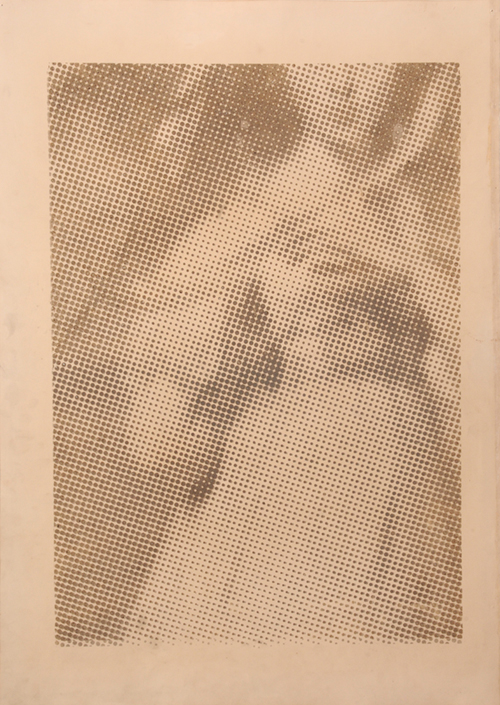
Continuing an ethos of “using materials that are to hand”, Chris Shaw’s practice has included the use of biro, tippex, office paper, dust, doodles, cello tape and moisturising crème. From these materials he develops ideas that inadvertently involve his everyday, and crucially, render that which is useful or used into something he considers, “not really that useful”. Previous works have involved the painstaking unraveling of a shirt that he wore whilst making work for his masters’ degree; another involved the meticulous collecting of debris from the surrounding grounds, which was then sieved and re-sieved to eventually create a residue for the floor work, Dustcrop (2008). The process of labour, and work have strong and equal (if contradictory) presence along side Shaw’s choice of materials. This is unanimously captured within the labour-intensive process Shaw also employs to create paintings he's cast from silicon moulds of canvas using acrylic paint. Among these, his Mask (2010) series, unify surface with apparatus in a way that confounds a sense of what facade and depth actually may be within the protocol of process and presentation.
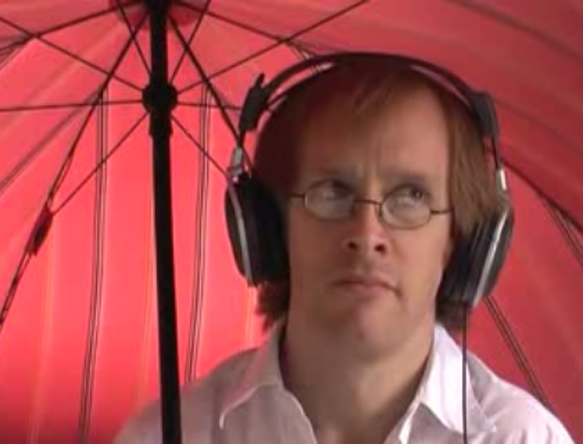
Whilst Shaw’s work is the result of protractiveness, Faulkner’s output directly stems from a sublimation of social media networking along the lines of a post-Warholian personality type. Through singular, poised images (available to view on Shaw’s website) and video vignettes, Faulkner pluralistically reforms into multi-versions of himself. With an equal measure of excitement and 'tedium vitae', Faulkner records his image at various points in his day and life: at work; at home; in the living room; reading; on day trips and so on, as if to imprint proof of himself inside a contemporary world, albeit in pixels and transient cyber bits.
The videos in this show have been chosen by Shaw, from an array of quickly produced ‘social ephemera’ from Faulkner’s life. Shaw draws out the similarities in both their approaches albeit through contrasting methods of production. What Shaw seems to be alluding to is a point of diversion between his lengthy artistic process and the quick fix, excessively consumptive mind-set of 21st century capitalism at large – two sides of the same currency.
The contrast between work and labour are underscored as simultaneously moot and pertinent. Shaw’s Mask 3, 4 and 1 (all 2010), comprise layers of paint, creating not only an ambiguity between the authenticity of its origin (actual canvas; fabric; cardboard supports and so on) but their surface also suggest human like forms; figures in the dark; malleated, hooded forms and holes that imply a looking out as well as inward. All of the works in the series are the same size and in the context of Faulkner’s videos and pictures, correspond to an idea of what Karl Marx called “character mask”, where he describes the sometimes forced multifarious social roles that workers adopt within a capitalist logic of pluralistic, production. Together these seem emblematic of a generically sublimated multi-tasking workforce ethic.
Consequently, what strikes across Vaudoux Follies, is an attitude shared by Shaw and Faulkner of being systematically not useful. Whilst this is done with a certain tongue in cheek humour, both men seem active in their disengagement with any notion of being happily ‘effective’ within any conservative social role. This ‘approach’ is deployed with a sense of time being tread, endured and spent unwisely.
A further, but subtle link, between the title of this exhibition is Shaw’s citation from Virginia Woolf’s 1925 novel, Mrs Dalloway, namely ‘What a lark! What a plunge!’ 2. The quote, which has obsessed much of Shaw's output, appears on the first page of the novel and foreshadows the stark contrasts between the books’ protagonists: Clarissa Dalloway, a middle class socialite; and Septimus Smith, her symbolic double, from a working class army background. They lead an entirely separate existence, as the novel swathes back and forth through time with contrasting narrative structures. Woolf sets up the increasingly suggestive relation between them through a sense of ethereality, and Clarissa’s potent imagination. Clarissa’s character seems obsequious, chattering as she does about the trivial affairs of her social moorings, whilst Septimus communicates essentially negative ruminations – as if in reaction to Clarissa’s overtly superficial concerns. Shaw sees a very loose – and importantly interchangeable, analogy to his and Faulkner’s personae and how they portray through Vaudoux Follies. “Almost no phrase wherein profoundity and playfulness do not tenderly hold hands”1.
Marbled through the exhibition are the permutations, failings and vague frustrations of human endeavour (– whether through negation or endurance), and human experience garnered, as it is, through a network of commercial and personally led, distractions, but construed in a way that slipknots any straight forward assumptions about meaning.
Predominantly, Shaw and Faulkner continue to share a profound understanding of a world at odds with itself, and their consequent (and seemingly irreverent) engagement (or dis-engagement) with it. Vaudoux Follies presents the subtle dynamic between the ways they interface their attitudes (or affect), with a world that just carries on with its business.
====================================
1 - Freidrich Nietzsche: ‘The Gay Science’ – cited by Bataille in his preface to ‘Inner Experience’; Bataille, George, SUNY press, 1988; trans. Leslie Ann Boldt.
2 - Mrs Dalloway – Virginia Woolf; Hogarth Press, 1925
Further reading:
Hannah Arendt: The Human Condition – University of Chicago Press, 1998 (originally published 1958).
Karl Marx: Capital Volume 1- A Critique of Political Economy: Penguin Books, 1990 (originally published 1867).
Mark Fisher: Capitalist Realism: Is there No Alternative? – Zero Books; 2009.
Georges Bataille: Inner Experience: SUNY press, 1988; trans. Leslie Ann Boldt.
The main drive is to not do much at all. It's hard to say why, I can only say that there are a lot of people engaged in making things. I know that's a strange reason but there it is. I'm not very good at doing nothing - that's difficult - but not doing much, and not doing much slowly, still leaves room for something to happen. Something always has to happen.
It's one thing to make work about emptiness and nothingness, but quite another to make work that aspires to be next to nothing.
If a material does come my way, my first thought is to let it go, but failing this (this exhibition is testament to my failure) I'm careful not to force or labour the material beyond its limitations.
To create an art object out of something is quite absurd, perhaps even immoral - which is why the art I most enjoy is close to unadulterated, or else unashamedly theatrical.
It is said that ideas often come out of the blue. But that's not quite true. In fact, ideas spring from a deep well of accumulated knowledge. If your well has dried up, don't roll your eyes at the heavens, but do get out more.
I don't make notes. I don't have a sketchbook. They'd only serve to remind me of ideas I'd prefer to forget I ever had.
Slowly does it. Especially if there's a deadline looming.
Selected quotes from Scott Daniel Faulkner's Facebook Wall
Scott Daniel Faulkner:
has completed the Saturday morning housework and is now scientifically proven to be at least 87% more Faye Dunaway.
sha'n't be unduly bothered by reality today
is eating the mouldy Christmas cake because it's the responsible thing to do.
now doubts the previous decision to eat that mouldy Christmas cake.
feels that minimalism is the answer to everything.
is finding it a bit Castrovalva (and a bit Warriors' Gate).
has spent the last two hours in the Eighteenth Century, en route to the Restoration.
associates with nothing that you call society.
would be reading Brett Easton Ellis before bedtime (if she wasn't such an idle bitch).
dreams of Less Than Zero whisking him away from the vicious, selfish realities of News International.
should be followed everywhere by a photographer and a group of screaming teenagers (of indeterminate gender).
recognises the similarities between himself and Wonder Woman are both horrifying and endless.
is reminded that Wonder Woman doesn't grow silly moustaches and spends her entire life pretending it's 1972 (and is suddenly very relieved that he is not Wonder Woman).
considers the sad decline in good manners and his thoughts turn, once more, to cannibalism
can't even be bothered to give up
rolled about on a melted Kit Kat and finds himself lacking hitherto self respect
leaps from remembering Kula Shaker to considering the merits of a back-street lobotomy
defaults at confusion and might yet resort to yet more make-up and hair products
aspires to become dangerously addicted to bad reviews
fondly recalls running into the sea in Aberystwyth, after half a brick
suspects all this "sitting about reading revenge tragedies" has rendered his hair SO PRETTY that the CCTV footage will be beamed "live" to Crime Watch
will continue pretending it's1485 for just a bit longer
marvels at just how the marketing department of Saxe-Coburg Gotha will brand the union of "W'an'K'"
might look a little less like Richard III, if he could just look a little less like Richard III
insists Tea is what happens to us, while we're busy making other plans.
IMAGES